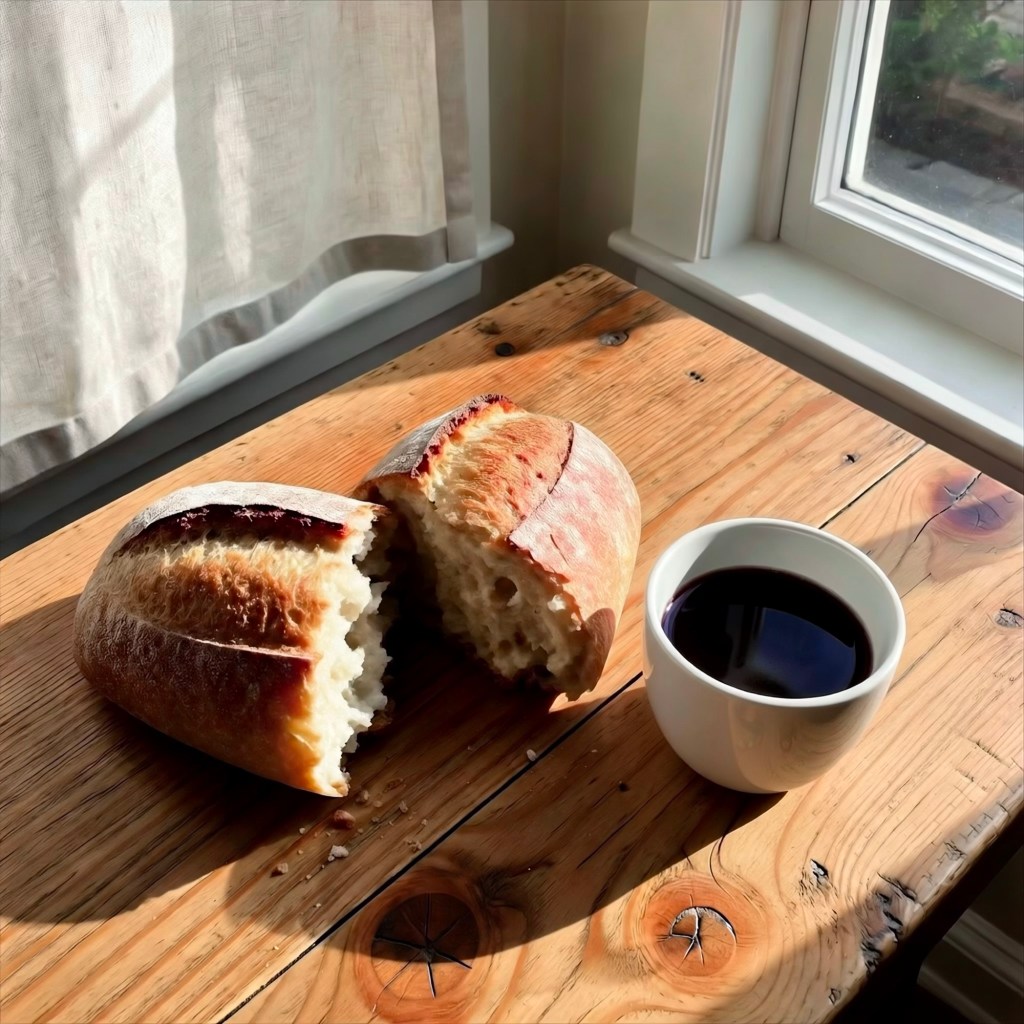
Today at church, we shared communion. The message centered on remembering Jesus and what he did for us. As I took the bread and the cup, I thought about what it means to love someone—and to carry that love through.
In Luke 22:7–20, Jesus gathered with his disciples for the Passover meal. He knew what was coming. The men sharing that table with him did not yet understand everything that lay ahead, but he did.
He took bread, gave thanks, broke it, and gave it to them. He spoke of his body, given for them, and told them to do this in remembrance of him. He shared the cup as the new covenant in his blood, poured out for them.
He was preparing them to remember a sacrifice he was about to make.
There are two names for Jesus that help me understand the meaning of that moment. Messiah means “Anointed One.” Immanuel means “God with us.”
God with us—in our world, among ordinary people, experiencing hunger, weariness, friendship, sorrow, and pain. The One I trust as my Savior understands suffering because he entered it himself.
In the garden before his arrest, Jesus prayed that, if possible, the cup might pass from him. He understood the agony ahead. Yet he surrendered to the Father’s will and willingly continued toward the cross.
His willingness moves me. He knew the cost, and he gave himself for us.
None of us is sinless. I know I’m not. I have made mistakes, followed my own judgment when I should have sought God’s direction, and tried to carry things I needed to surrender. I cannot make myself perfect. I cannot earn my own salvation.
Jesus knew our need. His love reached us there.
Remembering that has also made me examine how I understand love in my own life—both the love I offer and the love I accept.
When someone says, “I love you,” those words matter to me. They invite trust. They create hope. They carry a responsibility to treat another person’s heart with care.
I want a relationship where we can communicate openly and honestly. Especially across distance, that means real-time phone calls and video calls. It means hearing each other’s voice, seeing each other’s face, and making room for conversations that allow us to know one another.
I need someone willing to be present in those ordinary, practical ways.
If you say you will call, make the call. If you make a commitment, take it seriously. When something genuinely prevents you from following through, communicate honestly and arrange another time. Then keep that commitment.
I understand that life happens. People get tired. Plans change. All of us need patience and forgiveness. But when promises repeatedly remain promises, and live conversation keeps being postponed, trust suffers.
I cannot keep building a relationship around a future that never becomes part of the present.
That is something I need to acknowledge honestly, even when I care deeply about the person involved. Forgiveness can exist alongside a boundary. I can wish someone well and still require openness and consistency before continuing to invest my heart.
And I have to ask the same questions of myself. Do I make time? Do I listen? Do I keep my word? When I disappoint someone, am I willing to acknowledge it and make things right?
I want my actions to give someone good reason to trust me.
Falling in love involves risk. There is no way to open your heart while guaranteeing you will never be hurt. It takes courage to let yourself be known and to believe that another person might meet you with the same honesty.
But both people have to participate. Both have to be willing to move beyond the safety of carefully chosen words and share something of their actual lives.
Thinking about that brings me back to communion, and to the One whose faithfulness gives me hope.
Jesus went to the cross. He truly died. And on the third day, he rose again, as he had told his disciples he would.
The New Testament preserves the testimony of people who encountered him alive. They saw him and heard his voice. Thomas, who had struggled to believe the others, was invited to examine the wounds in Jesus’s hands and side. He responded, “My Lord and my God” (John 20:28).
The resurrection is central to my faith. I believe Jesus is God the Son, our risen Savior, and that death did not have the final word.
I was not there to witness those events personally. I receive the testimony preserved in Scripture and place my faith in him. I cannot see the wind itself, but I can see its effects. That helps me understand how something can be real even when it lies beyond what I have personally seen.
Through faith, I entrust myself to Jesus—to who he is and what he has done.
The forgiveness he offers is a gift of grace. I cannot earn it by working harder, getting everything right, or becoming good enough. I receive it with empty hands, trusting the Savior who gave himself for me.
That is what the bread and the cup bring me back to: his body given for us, his blood shed for us, and his faithfulness through suffering.
At that Passover table, Jesus spoke of what he would give. At the cross, he gave it. In the resurrection, he fulfilled his promise to rise again.
Immanuel. God with us.
He loved us. He gave himself for us.
And he lives.


Leave a Reply